Life in a garden

We need beauty because it makes us ache to be worthy of it. ~Mary Oliver

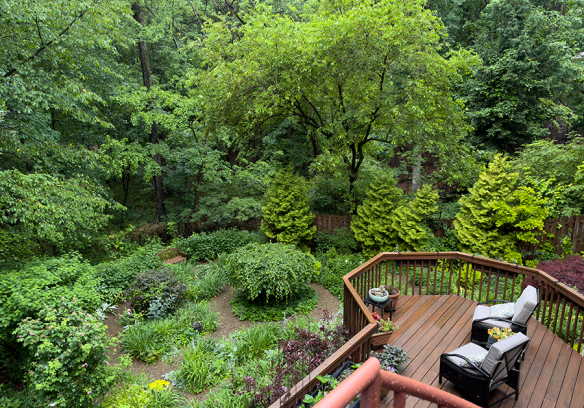
I stepped outside at dawn this morning to a tuneful chorus of birds in the trees above me. After days of torrential rain, the birds seemed to celebrate being able to hear their own songs again. But the rain was welcome after a month of heat and drought and the garden is lush and green again.
In my garden, after a rainfall, you can faintly, yes, hear the breaking of new blooms.” ~Truman Capote

I sometimes wonder how life can be this beautiful, this life in a garden. As I continue to leave behind the intention of striving for success in the world, I am content to allow the garden to rule my imagination and inner life. Last night I dreamed of orange poppies and purple alliums but walking through the garden this morning was more beautiful than any dream.
Give me odorous at sunrise a garden of beautiful flowers, where I can walk undisturbed . . . ~Walt Whitman

In late May and early June, the irises rang out color through the garden – bearded and Siberian iris are well known flowers and create bold imagery. (click on any thumbnail to see full size images)

Our less well known native Iris versicolor
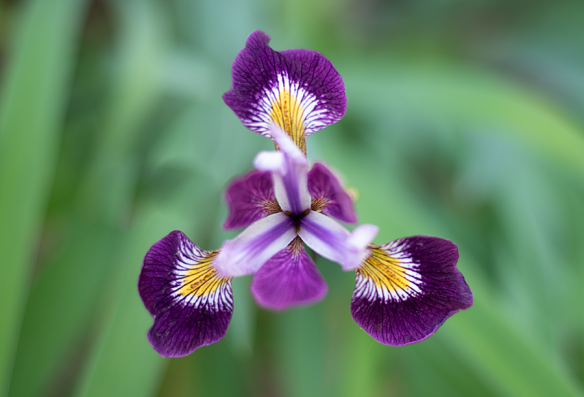
<em>Iris versicolor</em> 'John Wood'

and Iris virginica

<em>Iris virginica</em> with <em>Tradescantia ohioensis</em>

bring a quiet and subtle grace to the garden.

Watching the iris,
the faint and fragile petals –
How am I worthy? ~ Amy Lowell

On the cusp between May and June, peonies and allium bloom outside the fence where the herds of deer ignore them. My favorite peony is ‘Krinkled White’ whose single flowers expose the inner parts that feed the bees and yet resist falling to the ground after a rain.
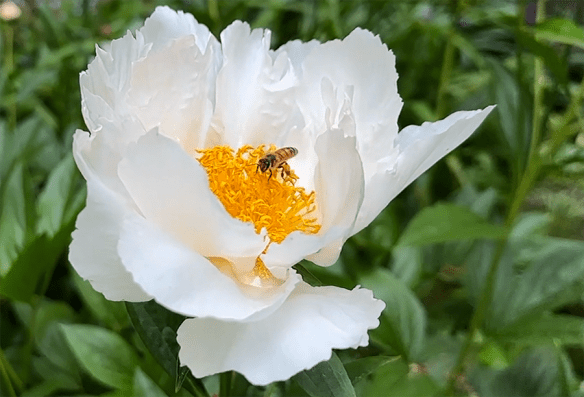
It is a fairy flower. Can you see it, touch it, smell it, and not love it? . . . The next time I live I wish I might be a single white peony so that people would . . . involuntarily catch their breath at the sight of me. ~Ruth Stout

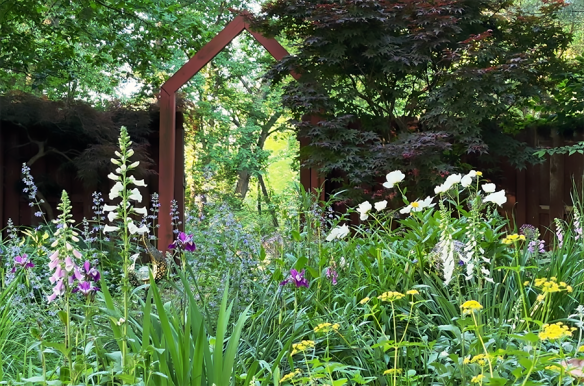
As June arrives, foxgloves and native iris join the peonies in the front garden to create a peak moment of bloom and offer more food for pollinators.
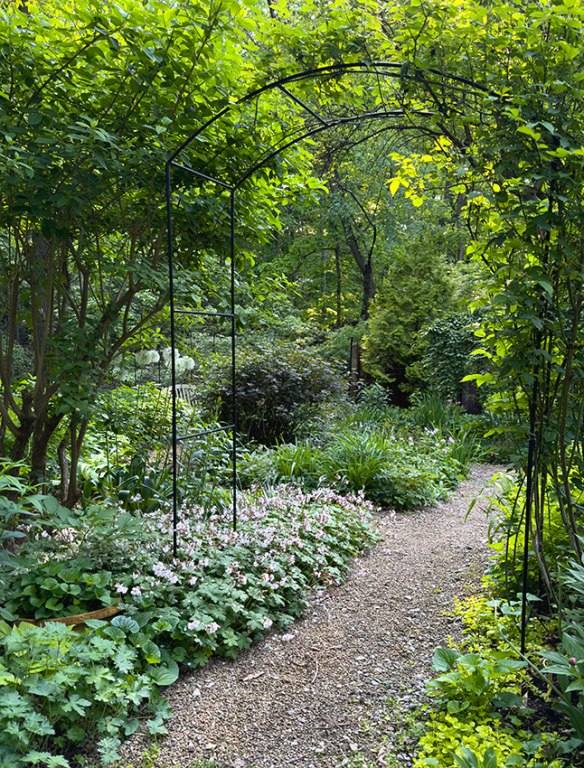
The roses lead into early summer, heavy with perfume and transcendent beauty that catches the light as the earth spins toward the solstice. The simple pink blossoms of rose ‘Complicata’ adorn the arbor above while geraniums and peonies add color underfoot.The single rose flowers catch the sun and spread their sweet scent in every direction.
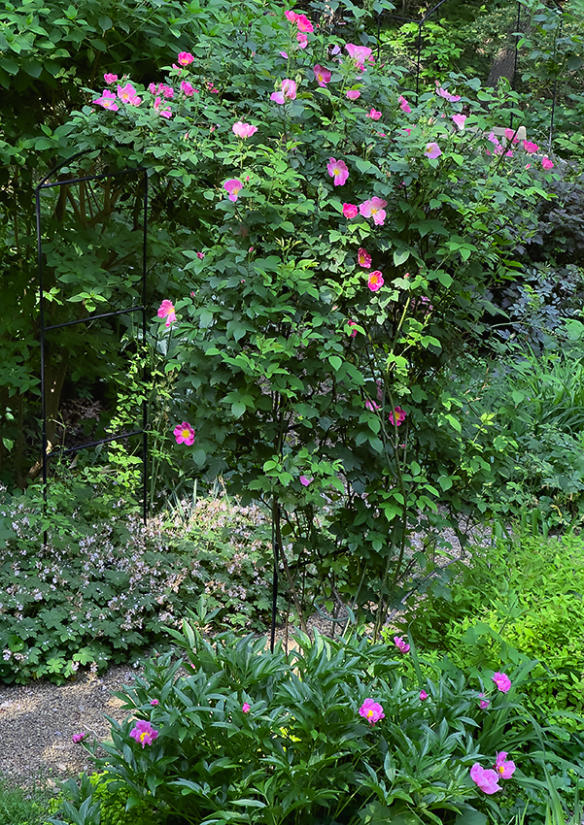
Rose, O you completely perfect thing, always self-contained and yet spilling yourself forever . . . ~Rilke

The lush blossoms of a David Austin pink rose throw a June garden party with Penstemon ‘Dark Towers’ and Clematis ‘Comtesse de Bouchaud’
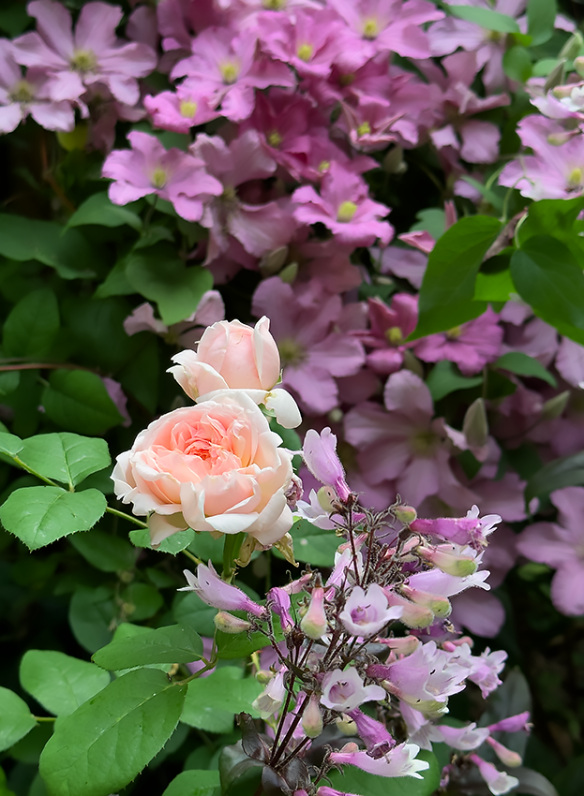
while the rich color and heady fragrance of ‘Rose de Rescht’ captures the eye and the nose.

. . . when I am alone I can become invisible. . . I can hear the almost unhearable sound of the roses singing ~Mary Oliver

The native white Hydrangea arborescens has begun its long summer bloom cycle as it surrounds the bench where I often sit in the shade of the woodland.

Pixie, sweet and ever present garden companion, just celebrated her second birthday.She asked if she could help me with garden chores. So grown up.

I filmed a slice of life in my garden from May into June filled with color and light. I invite you to walk with me through the garden that I love and treasure –  may you find pleasure in the shared journey.

Every day I see or hear something that more or less kills me with delight, that leaves me like a needle in the haystack of light. ~Mary Oliver

All photographs, video and text ©2023 by Lynn Emberg Purse except where noted, All Rights Reserved.

Fascination of Plants

Look deep into nature, and then you will understand everything better. ~Albert Einstein

I’ve been deepening my friendship with the camera this past year and using it to discover the beauty in my garden from new perspectives. As April shifted into May, the daffodils were replaced by Alliums and Camassias, bringing blue and purple hues into the garden. The grape and lemonade bed remained full of blooms until mid-May

but it was the graceful details of the Camassia flowers that drew my attention.

Alliums always remind me of giant lollipops on tall stems and they grow everywhere on the property, ignored by deer and rabbits.

Nature is an infinite sphere of which the center is everywhere and the circumference nowhere. ~Blaise Pascal

On closer inspection, those lollipops are globes of hundreds of small florets, each equipped with stamens full of pollen

beloved by bees.

A few late tulips reigned for weeks in the garden. Double tulip ‘Angelique’ is a favorite – her ruffled petals in shades of pink and white are a prelude to the peonies that follow.

A closer look at ‘Angelique’ in the garden

convinced me to cut a few blooms and photograph them on a light table to reveal the delicate translucence of her petals.

The poetry of the earth is never dead. ~John Keats

Almost black tulip ‘Queen of Night’ is another favorite and is still blooming in the garden. It’s sleek shiny flowers add deep notes to the color scheme

and captured the attention of Miss Pixie, who only sniffed and didn’t decapitate – she’s almost two now and has become a good garden citizen.

Columbines grown from seed pop up throughout the garden and are always welcome – the flower shapes with curving “tails” fascinate me.

Columbine ‘Wiliam Guinness’ was so covered with tiny spider webs and dew that it positively glistened in the morning light.

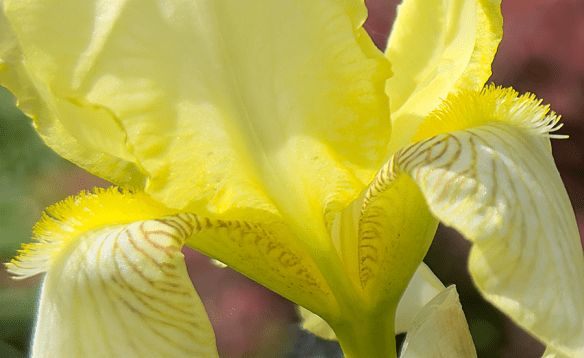
Iris season has begun, first with the dainty historical iris whose name I have forgotten but who always blooms first at the top of the hill overlooking the garden.

A closer look reveals subtle veining and her delicate yellow “beard” that gives Iris germanica its common name of bearded iris.

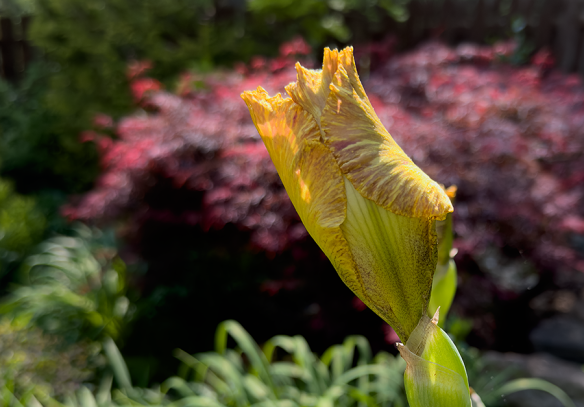
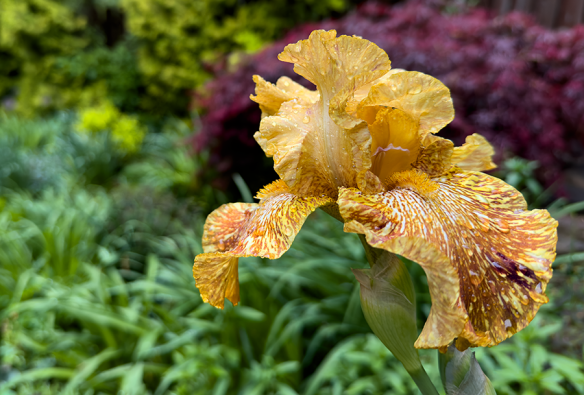
Bearded iris ‘Tiger Eyes’ looks as handsome in bud  as it does in flower.

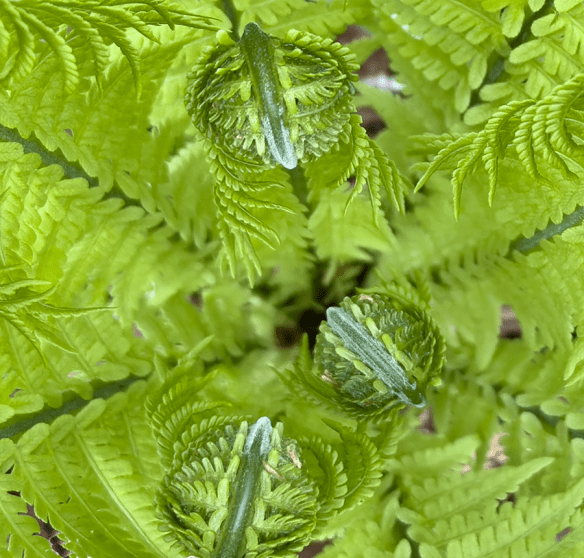
When our native ostrich ferns (Matteuccia struthiopteris) unfurled their long fronds, I took a closer look through the lens to discover all manner of shapes and patterns.

Ferns are well known as an example of fractals in nature – not only are fractals aesthetically pleasing but also thought to be stress-reducing. Looking into the heart of a fern is endlessly intriguing to me.

If you are as fascinated by plants as I am, you might be interested in the Fascination of Plants Day which was celebrated this past week on May 18. Founded by plant biologists as an annual celebration to raise awareness of the diversity, beauty and usefulness of plants, it has inspired plant-based events across the globe. (Special thanks to Steve Schwartzman of Portraits of Wildflowers for introducing me to FOPD) Whether you are a scientist or an artist or both or anything in between, enjoy and appreciate the wonderful world of plants. I wish you all a May filled to overflowing with the wild and elegant beauty of nature.

What is the good of your stars and trees, your sunrise and the wind, if they do not enter into our daily lives? ~E.M. Forster

For more on growth patterns of plants and some musical fun, see my post on the Fibonacci number series in nature and music.

All photographs and text ©2023 by Lynn Emberg Purse, All Rights Reserved, except where noted.


A Beautiful Habitat

In the past, we have asked one thing of our gardens: that they be pretty. Now they have to support life, sequester carbon, feed pollinators and manage water. ~Doug Tallamy

I went out in the garden during a break in the rain this weekend and the bumblebees had already emerged to feast again on Agastache ‘Black Adder’. New to the garden this year, this plant has been feeding pollinators for months as it spread its long arms and blue flowers through the blue and peach garden.

It has been a perfect summer for the garden, with plenty of rain and sun. In October, the growth is still lush in the cool temperatures and autumn rains.

After a strong pruning last year, the flower heads of panicle hydrangea ‘Limelight’ are enormous this season and a showpiece in the October garden. I’ve had my hands in the dirt (well, dirty gloves) all summer, leaving little time to write or share until now. In July, my garden was on a garden tour to benefit a local library and I taught a class in it for Phipps in September. It was the first time visitors have been here in three years. The “to do” lists for prepping the garden were long but with the help of my garden guys and my hubby, all was made ready for the hundreds of visitors. It was a joy to have people in the garden again, wandering through to the sound of Bill playing guitar on the deck. A special thanks to the volunteers from the Shaler Garden Club for their invaluable assistance and to my friend and fantastic photographer Mary Pegher for taking photos of the day (Photos below ©2022 Mary Pegher). (click any photo in the mosaic to see a full size image)

Last year was a year of rejuvenation – the garden beds were half empty by October after invasive and non-productive plants were removed. The remaining plants thrived this spring and hundreds of new plants, mostly natives for pollinators, were planted. The results made for a garden full of bees, butterflies, birds, and many other happy well-fed creatures.

The garden suggests there might be a place where we can meet nature halfway. ~Michael Pollan

The gardens outside the fence got an infusion of Monarda (bee balm), Agastache  foeniculum (anise hyssop), milkweed (Asclepias), Liatrus and Golden Alexander (Zizia aurea), much to the delight of the bumblebees and hummingbird moths. The anise hyssop continues to bloom with the goldenrod and zinnias.

I let the sun loving natives take over the south facing hillside and they attracted so many bees that my garden crew couldn’t work there on a sunny day.

The decks were stuffed with pots of salvias and Agastache rupestris which drew in the hummingbirds and bees and a poodle.

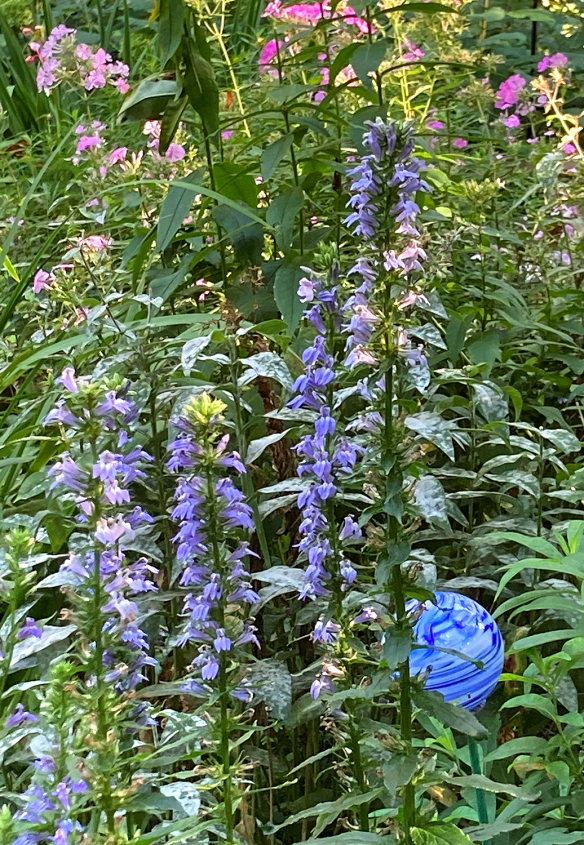
I made room in the blue and peach bed for a swath of great blue lobelia (Lobelia siphilitica) and tall phlox (Phlox paniculataamid a new set of glass globes in the blue garden.

The garden has buzzed for months with pollinators, more birds took up residence in the woods including some I’ve never seen or heard before and they fledged many babies over the season. And I learned to look more closely, listen more intently, and feel more connected to the garden than ever before.  Pixie and I spent many wonderful hours together in our little paradise.

I can think of no better form of personal involvement in the cure of the environment than that of gardening. A person who is growing a garden, if he is growing it organically, is improving a piece of the world. ~Wendell Berry

Here is a short video of the pollinators in my garden throughout this year; enjoy!  

All text, photos, and video ©2022 Lynn Emberg Purse, All Rights Reserved, except where noted.

Honey-sweet May

At last came the golden month of the wild folk—honey-sweet May, when the birds come back, and the flowers come out, and the air is full of the sunrise scents and songs of the dawning year. ~Samuel Scoville Jr, Wild Folk

Today is one of those perfect days in May. Birds are singing outside of every open window and soft breezes keep the air fresh and cool. Pixie and I have been gardening at sunrise for the past few days – she keeps a close eye on the wildlife while I work.There was no hurry or bustle this morning, just a task completed here and another one begun there with no sense of a clock ticking or a checklist to follow. Time was instead measured by new flowers opening, the sudden low buzz of a hummingbird passing, and the occasional visit from a fat bumblebee.

Queer things happen in the garden in May. Little faces forgotten appear, and plants thought to be dead suddenly wave a green hand to confound you. ~W. E. Johns

In just a few days, the woods have shifted from a misty breath of new growth that barely shaded the garden

to a lush green canopy that creates shadows and mystery in the late afternoon sun.

Horticulturally, the month of May is opening night, Homecoming, and Graduation Day all rolled into one. ~Tam Mossman

The garden beds are burgeoning with growth as new flowers emerge every day.The spring bulbs have finished for the season – one final blossom of the summer snowflake (Leucojum aestivum) lingers among the ferns. Allium and Camassia, the bulbs of May, come forward to have their say in shades of purple and blue while Lilac ‘Miss Kim’ is just starting to bloom. (Click on any photo to see the full size image)

The lovely Geum ‘Mai Tai’ – whose buds are as pretty as the flowers – blooms with abandon

while the hardy geraniums and woodland phlox bring a frothy grace to the garden beds.

The delicate yellow blooms of heirloom Iris germanica ‘Flavescens’ reign over the garden from their perch along the stone wall.

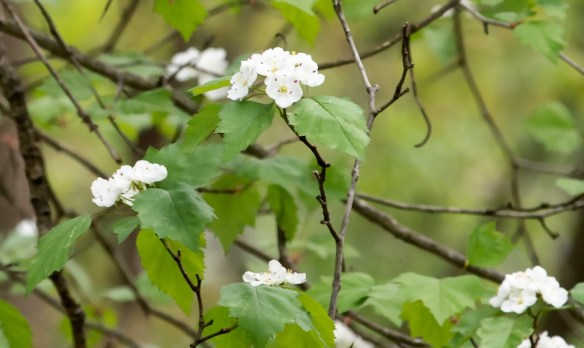
I discovered a native tree in the woods below the garden, blooming for the first time ever. Pennsylvania hawthorn (Crataegus pennsylvanica) is self-pollinating so its berries should feed the birds this fall. In the meantime, I am enjoying its white blossoms and graceful shape.

Last evening, Pixie and I sat in front of the yellow iris and listened to a wood thrush sing; it was the perfect end to a perfect day. Have a listen and enjoy the honey-sweet days of May. 

And a bird overhead sang follow, and a bird to the right sang here. And the arch of the leaves was hollow, and the meaning of May was clear.” ~ Algernon Charles Swinburne

This post is part of the Garden Bloggers Bloom Day, hosted by Carol at May Dreams. Visit her site to see what’s blooming around the world today.

April Moon

The moon, like a flower in heaven’s high bower, With silent delight Sits and smiles on the night. ~William Blake

These past few nights, Pixie and I have wandered through the garden under the light of an almost full April moon. The tiny flashlight I carry stays in my pocket, unneeded, as we travel the light gravel paths, stop to smell the cherry blossoms, and admire the way the lichen on the stone steps reflects the moonlight. I sit for a while in a garden chair and watch Pixie explore the woods; sometimes she sits and looks at the sky as if she admires the stars too.

Winter has returned again and again these past few weeks, sometimes with mounds of snow and sometimes just with bitter plant-slaying cold. Mark Twain was exactly right when he said “in the spring I have counted one hundred and thirty-six different kinds of weather inside of forty-eight hours.” Pixie didn’t seem to mind the snow but the green lady was definitely not amused.

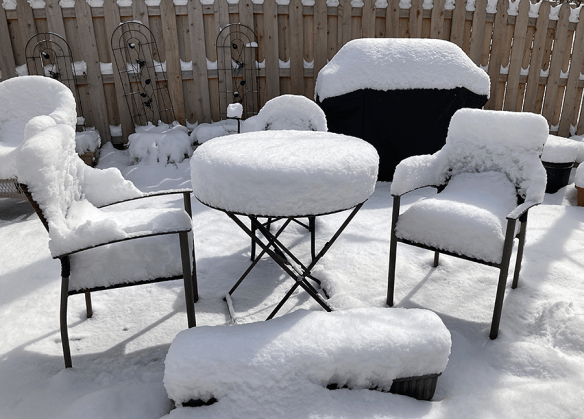
Fortunately, the snow that covered the patio furniture last month

has melted into the ground to nourish the flowers. And finally, they have emerged. The hellebores (Helleborus orientalis)are always the first to bloom (click on any photo in the mosaic to see a full size image)

along with the cheerful blue blossoms of Iris reticulata ‘Harmony’.

Now that the temperatures have warmed and the sun has returned, more flowering bulbs emerge and bloom every day.

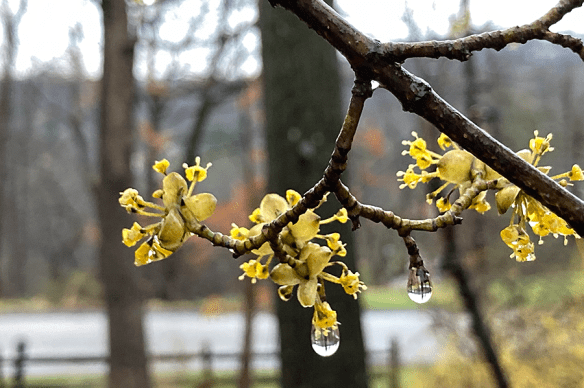
The Cornelian cherry (Cornus mas) always blooms early

while the leaves of our native Hydrangea quercifolia (oak leaf hydrangea) are just beginning to emerge in their perfect geometry.

The promise of more to come is held in the new foliage of Phlox paniculata and purple sedum along with the flower buds of lilac ‘Miss Kim’.

The dawn chorus has been glorious – the birds are here and nesting and the woods are full of their songs. Robins are building a nest on our front porch, they are sociable and don’t seem to mind our comings and goings. In fact, they tap on our front door when they want more water in the birdbath.

One never knows the idyllic charm of our northern woods who has not seen them in April, when it is all a feast of birds and buds and waking life. . . This month belongs to the birds and flowers; but most of all to the robin. ~Fannie Hardy Eckstorm, American writer and ornithologist

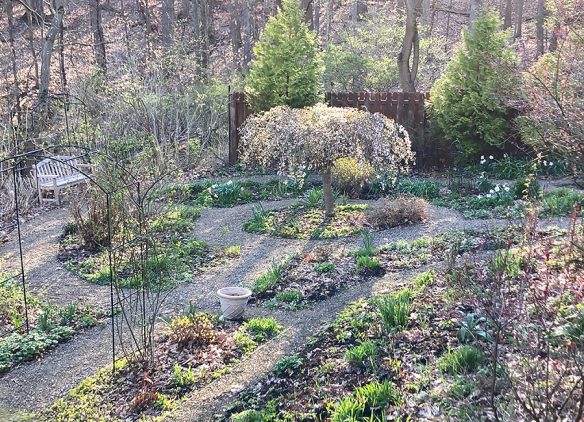
Last evening, the April sun slanted through the circle garden to the buzz of hungry bees and wasps feeding on the weeping cherry blossoms. Spring has finally arrived, beautiful and welcome. Tomorrow night, the April moon will be full and I expect that Pixie and I will again walk in the garden under its brilliant light. 

What other body could pull an entire ocean from shore to shore? The moon is faithful to its nature and its power is never diminished. ~Deng Ming-Dao

Did you know that the first full moon after the vernal equinox determines the date of Easter? Read about it here.

This post is a part of the April edition of Garden Blogger’s Bloom Day, hosted by Carol Michel at May Dreams Gardens. Click on the link to see other gardens blooming around the country!