I have nothing to say and I am saying it . . . ~John Cage
I have nothing to say and I am saying it . . . ~John Cage
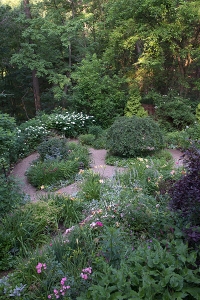
A few weeks after all of the visitors left my summer garden, construction began. The house and deck got a new coat of stain, a job delayed from the spring because of wet weather. Then the garden walls came tumbling down. When we m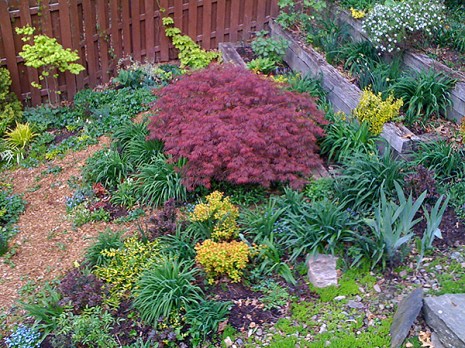 oved here, terraces led down the hill supported by thick wooden ties. I was happy to have level spaces to plant but over the years, the wood rotted away, leaving only rusty metal spikes and crumbling wood on the hillside, as you can see in this
photo. It was too dangerous to even step in the beds! Fortunately, by June the plants had filled out and covered the bad bits during my garden tours this summer, but I was ready to have my vision of curving stacked stone walls put into place.

It broke my heart to dig up the hillside in early September so that work could begin – this was a favorite spot for birds and insect pollinators and the Rudbeckia were in full bloom. My friend and colleague Bill Lucki of Natural Garden Design agreed to tear out the rotting wood ties and replace them with stacked stone walls, so I set to work moving plants to make way for the construction project.
Ten days after construction began, the walls were complete and ready for re-planting; Bill and Ron did a fabulous job!
Other parts of the garden continued to bloom and thrive during this process, and as I began to replant the hillside, it started to settle in and look as if it was always there.


While the weather holds, I continue to plant and dream of next year’s bloom among the handsome stone walls.
“To dream a garden and then to plant it is an act of independence and even defiance to the greater world.” ― Stanley Crawford
Nature’s message was always there and for us to see. It was written on the wings of butterflies. ~Kjell B. Sandved
 The garden in August is as much a garden of creatures and sound as it is of flowers. As the flowering season comes to a crescendo, the garden becomes a “last chance buffet” for every creature gathering food stores for winter or for migration. The cicadas buzz in the woods throughout the day; in the evening, the frog chorus breaks out into pulsing serenades of courting. Bees of every size and shape buzz around the richest sources of pollen, butterflies flitter and float through the air and compete with the bees for flower landing space, hummingbirds visit every tubular flower for nectar. This is the time of the year that the gardener needs to step aside and enjoy a ringside seat to the panorama of life in the garden. Here’s a sample of the frog chorus at night. (Audio recorded and edited by Bill Purse)
A few years ago, a serious health crisis made me an observer rather than a participant in my garden for a season or two. Even as the weeds grew unhindered, the flowering plants also bloomed without my help and were covered in bees and butterflies for months. It became apparent to me that tidiness was not a priority of Mother Nature; her priority apparently was growth abundant, unruly and rich with life. While I still enjoy playing with color and texture and form, my garden priorities are now more aligned with those of Mother Nature to support the life of creatures around me. Happily, creating a refuge for pollinators can also result in a beautiful refuge for the gardener.
We have entered an age of environmental gardening. Given the afflictions of our planet, this is overwhelmingly positive as long as we remember that the one creature most in need of refuge in the garden is the gardener. ~Adrian Higgins, The Washington Post
Each morning, Angel and I explore the garden. It is lush and overflowing, full of wings and buzzing and singing.
The hillside that in July was covered with daylilies is now overflowing with the cheerful gold of native brown-eyed Susans (Rudbeckia hirta and R. triloba) that are favorites of both butterflies and bees.
Golden flowers abound this time of year and are a favorite of pollinators. For the first time, the Silvery Checkerspot butterfly has made an appearance. (Click on any image in the mosaic to see the full size photo).


The deck garden is anchored on one end by a large stand of purple coneflowers and on the other end by single roses and Persicaria ‘Firetail’ – all attract a bevy of native bees and butterflies throughout the day.


Lush Hydrangea blossoms form a backdrop to a tall swath of native Phlox paniculata in shades of lavender and purple, a favorite of the yellow swallowtail butterflies. Planting in groups helps pollinators gather food with the least energy expended, so I’ve begun to allow their favorite plants to increase and spread. Birdbaths tucked into flower beds provide essential water.


 Every garden is a work in progress and changes over time. I have been gently steering my garden toward one that supports winged life – this year it was certified as a Pollinator Friendly Garden through the Penn State Master Gardeners program. Just one more step in creating a place where all the parts fit and work together as a whole. Want to know more? Visit pollinator.org for information on National Pollinator Week and easy steps you can take to support life on our planet.
The first law of ecology is that everything is related to everything else. ~Barry Commoner, American scientist
Except where noted, all images, sound and text ©2016 Lynn Emberg Purse, All Rights Reserved.
Deep summer is when laziness finds respectability. ~ Sam Keen
 There is always a certain morning in summer that seems magical, that moment when I step outside into a quiet world and say to myself “summer has arrived.” This morning, late in July, I finally had that moment. The sun in the eastern sky lit the trees along the road with a golden light, a wood thrush greeted me with its distinctive song, and the soft warm air promised a hot sunny day to come. I had no agenda other than to wander through the garden with Angel, accompanied by the drone of cicadas and the calls of robins and bluejays.
The garden is lush, almost voluptuous in its beauty, thanks to hot days and frequent thundershowers.
The daylilies are finishing their season, with a few welcome malingerers.


The roses have caught their second wind with fresh foliage and fulsome blooms.


The hydrangeas are bowed to the ground with a bounty of creamy white blossoms, fragrant and covered with tiny pollinators gathering food. Their busy wings remind me of last night, when I watched hundreds of fireflies rise up from the garden to sparkle and flicker their way into the trees.


This was not a morning to rise before dawn and do the hard work of weeding and digging for hours in order to prepare for visitors. This was a lazy quiet morning to soak in every sight, sound, and scent the garden offered, a gift of deep summer, when the burdens of the world fade for a few hours and I live in the moment.


The perfect song for a lazy summer day: Barbra Streisand’s “Lazy Afternoon”
Rest is not idleness, and to lie sometimes on the grass under trees on a summer’s day, listening to the murmur of the water, or watching the clouds float across the sky, is by no means a waste of time. ~John Lubbock, The Use Of Life
As a child, my favorite Laura Ingalls Wilder book was “Little House in the Big Woods“. When we began to look for a larger property to garden fifteen years ago, it was no surprise that I fell in love with a house tucked into the middle of an acre of woods. I wanted to be surrounded by trees in a home that was an integral part of the landscape and I got my wish. Every level of the house has a door to the outside, sometimes three or four, and two levels of decks make walking out into the landscape an every day joy. ~Lynn Emberg Purse, A Garden in the Woods (Pittsburgh Botanic Garden tour book)
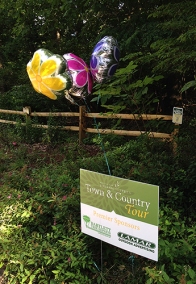 On the last Sunday in June, I opened my garden for the annual Pittsburgh Botanic Garden Town and Country Tour – an all day event where visitors explore selected local gardens. A few days later, I was told that 500 tickets were sold; I think everyone of those people came through my garden! I had worked for months to prepare the garden for close scrutiny, still prepping until ten minutes before the garden gates opened. I was especially pleased that many visitors made a point of telling me that they chose to come here first because of the description I wrote of the garden, beginning with the paragraph above.
 My generous husband serenaded everyone by playing guitar on the deck for many hours of the tour. I loved greeting visitors, answering their questions, and discussing approaches to gardening. One of the comments that I heard over and over again was “this is a sanctuary!” and I would agree with a smile. Here is what those on tour saw as they explored the garden, with the text taken from the garden tour description. You can listen to Bill’s guitar wizardry on Woman In the Meadow (composed by Mark Lucas, recorded on the Tribute CD by Bill Purse) while you enjoy the photos (all images ©2016 Lynn Emberg Purse, All Rights Reserved).
Visitors arrive outside of the fence where many plants have been tested for deer resistance. Native plants rub shoulders with polite foreigners, each adding to the beauty of the garden while supporting a variety of wildlife. Flowers, grasses, herbs, shrubs and groundcovers thrive in relaxed casual planting beds that connect to the surrounding woodland.


Inside the fence, the open areas embraced by a tall backdrop of woods contain a formal structure of circular gravel paths and beds filled with striking color.


Hundreds of roses, lilies, daylilies, clematis, Hydrangea, perennials, and hosta make up the romantic plantings that thrive protected from deer and rabbits.


Rugged stone steps lead from the gardens up to the deck where visitors can get a “bird’s eye” view of the planting beds.


Although this is a “one woman” garden, I want to extend a special thanks to my niece Carly, my friend Doug, and my husband Bill who helped me prepare the garden and grounds, and my sister-in-law Susie and all of the volunteers from the Pittsburgh Botanic Garden who helped the tour day run so smoothly.
Home is the nicest word there is. ― Laura Ingalls Wilder
This post is linked back to Jude’s monthly theme of August: Open Gardens. You can explore some fabulous gardens there!
 composerinthegarden