Every spring is the only spring – a perpetual astonishment. ~Ellis Peters
A week of sun and rain has changed everything. The garden grows greener by the minute, more flowers are blooming each day. The small islands of early flowers and foliage are growing larger and starting to connect throughout the garden. It looks and smells like spring. The wild cherries and amelanchier are blooming throughout the woods with clumps of summer snowflakes blooming beneath. (Click on any photo in these mosaics to see a full size image)
The later daffodils are beginning to bloom and have escaped being felled by sub-zero temperatures.
Daffodils in Grape & Lemonade bed
Daffodil ‘Thalia’
Daffodil ‘Sentinel’
Daffodil ‘Geranium’
Daffodil ‘Bella Coola’
Daffodil ‘La Traviata’
The tulips are coming into bloom, along with some early perennials.
Tulip ‘Marianne’
Tulip ‘Shirley’
Tulip ‘Orange Princess’
Pulmonaria longifolia ‘Bertram Anderson’
Tulip ‘Apricot Beauty’
Brunnera macrophylla ‘Alexander’s Great’
Groundcovers
Spring star flower (Iphieon uniflorum)
Spring seems to have arrived in earnest, perpetually astonishing in its loveliness.
This post is a part of Garden Bloggers’ Bloom Day, a monthly event sponsored by May Dreams Gardens. You will find links to over fifty beautiful gardens blooming in April – have fun exploring!
The call of spring seems to be louder, sweeter, more siren-like, than ever before. The longing to get closer to nature, fills the heart. ~M.F. Canfield
The sun was warm but the wind was chill.
You know how it is with an April day. ~ Robert Frost
Spring has arrived with great hesitation, or perhaps I only greet it this way. Warm days abruptly end in snow or frost, pouring rain soaks the ground and triggers green growth which is then stopped short by another deep freeze. I’ve never witnessed such extreme disruption in the garden. Although many of the early daffodil blooms hang to the ground in surrender, other growing things, especially ones native to this area, are coping with the dramatic and abrupt changes and reveal their beauty to the eye. I must admit to a deep uneasiness – will this scenario continue in the future as we grapple with climate change? How will the creatures who depend on pollen and other garden foods at crucial times cope or even survive? Here’s what the National Wildlife Federation has to say about gardening for climate change and the problems that changing bloom times create between pollinators and the plants they depend on.
Nevertheless, each day brings new growth and beauty. The hellebores continue to spring back after the worst conditions and a few sleepyheads are just beginning to bloom now. Bird song is a constant soundtrack to my journeys through the garden and a pair of robins follow me around as I expose the earth while digging up dandelion roots. The first blooms on the weeping cherry that survived sudden sub-zero temperatures are nuzzled by a native bee desperate for spring pollen. Tiny wind anemones and grape hyacinth bloom amid the warm rock walls. Foliage in shades of green and red rises up from the ground, displacing the last of the fallen oak leaves that blanketed the beds all winter. Now is the time for cleaning up the garden, trimming roses and shrubs, and planting seeds indoors in anticipation of summer. Prolific rains have created vernal pools and streams through the woods and spring peepers have been singing their high chweeps of courtship on warmer evenings.
But days even earlier than these in April have a charm, – even days that seem raw and rainy . . . There is a fascination in walking through these bare early woods, – there is such a pause of preparation, winter’s work is so cleanly and thoroughly done. Everything is taken down and put away . . . All else is bare, but prophetic: buds everywhere, the whole splendor of the coming summer concentrated in those hard little knobs on every bough . . . ~Thomas Wentworth Higginson, “April Days,” 1861
A special thanks to The Quote Garden for a seemingly endless source of literary inspiration.
Deep summer is when laziness finds respectability. ~ Sam Keen
There is always a certain morning in summer that seems magical, that moment when I step outside into a quiet world and say to myself “summer has arrived.” This morning, late in July, I finally had that moment. The sun in the eastern sky lit the trees along the road with a golden light, a wood thrush greeted me with its distinctive song, and the soft warm air promised a hot sunny day to come. I had no agenda other than to wander through the garden with Angel, accompanied by the drone of cicadas and the calls of robins and bluejays.
The garden is lush, almost voluptuous in its beauty, thanks to hot days and frequent thundershowers.
The daylilies are finishing their season, with a few welcome malingerers.
Hillside in mid-July
Susan Weber
Mystical Rainbow
Inquire Within
Persian Ruby
Later Alligator
El Desperado
Eggplant Ecstasy
Daylilies in full bloom
The roses have caught their second wind with fresh foliage and fulsome blooms.
Ambridge Rose
Charles Rennie Macintosh
The hydrangeas are bowed to the ground with a bounty of creamy white blossoms, fragrant and covered with tiny pollinators gathering food. Their busy wings remind me of last night, when I watched hundreds of fireflies rise up from the garden to sparkle and flicker their way into the trees.
Hydrangea ‘Limelight’
Hydrangea arborescens ‘Annabelle”
Garden in late July
Echinacea and Hydrangea
This was not a morning to rise before dawn and do the hard work of weeding and digging for hours in order to prepare for visitors. This was a lazy quiet morning to soak in every sight, sound, and scent the garden offered, a gift of deep summer, when the burdens of the world fade for a few hours and I live in the moment.
Echinacea ‘Ruby Star’ & Phlox paniculata
Lily ‘Altari’
Agastache rupestris
The perfect song for a lazy summer day: Barbra Streisand’s “Lazy Afternoon”
Rest is not idleness, and to lie sometimes on the grass under trees on a summer’s day, listening to the murmur of the water, or watching the clouds float across the sky, is by no means a waste of time. ~John Lubbock, The Use Of Life
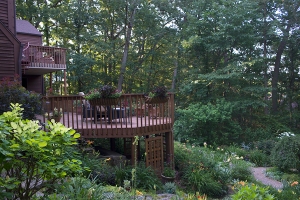
As a child, my favorite Laura Ingalls Wilder book was “Little House in the Big Woods“. When we began to look for a larger property to garden fifteen years ago, it was no surprise that I fell in love with a house tucked into the middle of an acre of woods. I wanted to be surrounded by trees in a home that was an integral part of the landscape and I got my wish. Every level of the house has a door to the outside, sometimes three or four, and two levels of decks make walking out into the landscape an every day joy. ~Lynn Emberg Purse, A Garden in the Woods (Pittsburgh Botanic Garden tour book)
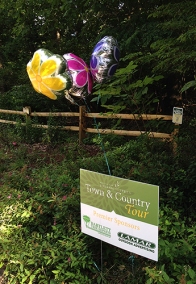
On the last Sunday in June, I opened my garden for the annual Pittsburgh Botanic Garden Town and Country Tour – an all day event where visitors explore selected local gardens. A few days later, I was told that 500 tickets were sold; I think everyone of those people came through my garden! I had worked for months to prepare the garden for close scrutiny, still prepping until ten minutes before the garden gates opened. I was especially pleased that many visitors made a point of telling me that they chose to come here first because of the description I wrote of the garden, beginning with the paragraph above.
Visitors arrive outside of the fence where many plants have been tested for deer resistance. Native plants rub shoulders with polite foreigners, each adding to the beauty of the garden while supporting a variety of wildlife. Flowers, grasses, herbs, shrubs and groundcovers thrive in relaxed casual planting beds that connect to the surrounding woodland.
Herb circle garden
Pulmonaria and Polka-dot plant (Hypoestes)
Garlic heads line the path to the birdbath
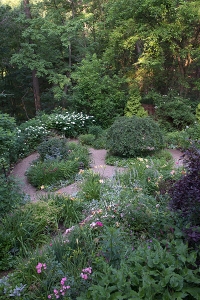
Inside the fence, the open areas embraced by a tall backdrop of woods contain a formal structure of circular gravel paths and beds filled with striking color.
Clematis viticella alba
Gateway into the woods
Central circle
Daylily hill
Hundreds of roses, lilies, daylilies, clematis, Hydrangea, perennials, and hosta make up the romantic plantings that thrive protected from deer and rabbits.
Blue birdbath with ostrich ferns and hostas
Daylily ‘Blue Eyed Butterfly’
Daylily, roses, and Campanula ‘Wedding Bells’
Rose ‘Carefree Beauty’
Daylily ‘Evelyn Lela Stout’ and rose ‘Amber Carpet’
Grape and lemonade bed
Daylily ‘Etched Eyes’ and Coleus ‘Gay’s Delight’
“Flora” bench embraced by Hydrangea arborescens ‘Annabelle’
‘Carpet Pink’ rose and Tradescantia ohioensis
Daylily ‘Strawberry Fields Forever’
Rugged stone steps lead from the gardens up to the deck where visitors can get a “bird’s eye” view of the planting beds.
Daylily ‘Tiger Eye Spider’ lighting up the hillside
Gardens flanking stone steps
Garden beds viewed from the lower deck
Supertunia ‘Honey’ on deck
View from upper deck
Although this is a “one woman” garden, I want to extend a special thanks to my niece Carly, my friend Doug, and my husband Bill who helped me prepare the garden and grounds, and my sister-in-law Susie and all of the volunteers from the Pittsburgh Botanic Garden who helped the tour day run so smoothly.
They are not long, the days of wine and roses
Out of a misty dream
Our path emerges for a while, then closes
Within a dream. ~Ernest Dowson, from “Vitae Summa Brevis” (1896)
‘Rose de Rescht’
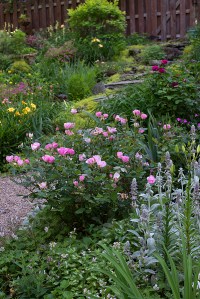
As I walk down the steps into the lower garden, the air is adrift with the scent of roses in the sun. The heady fragrance of the old fashioned ‘Rose de Rescht’ lining the deck garden perfumes the air around it. The lighter notes of English rose ‘Tamora’ greet me as I turn to the peach and blue area of the garden. ‘Winter Sunset’ displays its classic tea rose form but is a hardy soul, bred for Iowa winters by Griffith Buck. Lilies are beginning to bloom too and they add their scented song to the mix. A cascade of single white flowers covers the fence where hybrid musk rose ‘Darlow’s Enigma’ reigns beneath the shadow of a mulberry tree, intertwined with the purple and white blossoms of Clematisvit. ‘Venosa Violacea’, the perfect companion for roses. Tiny sweet clusters of plum purple flowers cover ‘Sweet Chariot’ rose, backed by the stars of Clematis ‘Margo Koster’ weaving through the arms of eastern ninebark ‘Diablo’ (Physocarpus opulifolius). The Carpet roses are putting on a show – Rainbow, Coral, Pink – and what they lack in scent, they make up for in extravagance of bloom.


 Spring has arrived with great hesitation, or perhaps I only greet it this way. Warm days abruptly end in snow or frost, pouring rain soaks the ground and triggers green growth which is then stopped short by another deep freeze. I’ve never witnessed such extreme disruption in the garden. Although many of the early daffodil blooms hang to the ground in surrender, other growing things, especially ones native to this area, are coping with the dramatic and abrupt changes and reveal their beauty to the eye. I must admit to a deep uneasiness – will this scenario continue in the future as we grapple with climate change? How will the creatures who depend on pollen and other garden foods at crucial times cope or even survive? Here’s what the National Wildlife Federation has to say about
  Nevertheless, each day brings new growth and beauty. The hellebores continue to spring back after the worst conditions and a few sleepyheads are just beginning to bloom now. Bird song is a constant soundtrack to my journeys through the garden and a pair of robins follow me around as I expose the earth while digging up dandelion roots. The first blooms on the weeping cherry that survived sudden sub-zero temperatures are nuzzled by a native bee desperate for spring pollen. Tiny wind anemones and grape hyacinth bloom amid the warm rock walls. Foliage in shades of green and red rises up from the ground, displacing the last of the fallen oak leaves that blanketed the beds all winter. Now is the time for cleaning up the garden, trimming roses and shrubs, and planting seeds indoors in anticipation of summer. Prolific rains have created vernal pools and streams through the woods and spring peepers have been singing their high chweeps of courtship on warmer evenings.


 There is always a certain morning in summer that seems magical, that moment when I step outside into a quiet world and say to myself “summer has arrived.” This morning, late in July, I finally had that moment. The sun in the eastern sky lit the trees along the road with a golden light, a


 As a child, my favorite
  On the last Sunday in June, I opened my garden for the annual
  My generous husband serenaded everyone by playing guitar on the deck for many hours of the tour. I loved greeting visitors, answering their questions, and discussing approaches to gardening. One of the comments that I heard over and over again was “this is a sanctuary!” and I would agree with a smile. Here is what those on tour saw as they explored the garden, with the text taken from the garden tour description. You can listen to Bill’s guitar wizardry on Woman In the Meadow (composed by Mark Lucas, recorded on the Tribute CD by




 composerinthegarden