It is late August, the days are filled with the steady murmur of cicadas and the nights resound with the addition of a wood frog chorus that surrounds on all sides. This is my favorite time of year. The garden is lush and filled with late summer blooms of gold and purple and demands little from the gardener. Butterflies and hummingbirds flit around like living jewels, feeding on pollen that will speed their journey south in a few weeks. Storm clouds come and go, creating shifting patterns of light and shadow. The county park nearby celebrates the season with stands of goldenrod and Joe Pye weed.
This slideshow requires JavaScript.
One year ago today, I began the Composer in the Garden blog and I want to thank everyone who has visited, liked, commented and followed. I have learned so much and have made so many friends. This community has offered me a place to explore ideas and commit to creating and presenting my music and images on a regular basis. This week, I am in the middle of composing a new piece, “August in Penns Woods” which will use a recording of the sound of my garden as both inspiration and as part of the piece itself. The year has come full circle. Here is my first ever post, The Sound of the August Garden, that contains the sound file that will serve as the basis for this new piece.
Thank you, my friends, and I look forward to another year.
A few weeks ago, in Breathe In, Breathe Out – I wrote about “Breath” – the piece I composed this spring as part of a larger piece The Four Elements. Deeply immersed in recording “Breath” this past week, I’ve also found the lyrics to this song moving from my head as an ongoing mantra to flooding my creative veins and taking over my life. It’s not only about remembering to breathe, it is about finding balance in “the space between.”
So what is “the space between”? When I practice deep breathing, I often imagine the astonishing amount of open space in our atomic structure, the space between the photons and electrons and neutrons, the vast space between the cellular structure of our bodies.
But I also think of the idea of liminal space.
Threshold between gardens
The term “liminal space” comes from the Latin wordlīmen, which in part signifies the boundary between one space and another, meaning that “betwixt and between” space, the threshold of a door or the threshold between stages of life. This is not a new idea by any means – consider the practice of carrying a bride over the threshold, of the ceremonies involved in the rite of passage from one stage of life to another, the superstitions and ritual practices surrounding the opening and closing of doors, windows, and other passageways. In garden design, the liminal structures of gates, archways and paths become the defining elements of the garden and invite the visitor to move through the space rather than look at it from a distance.
The “space between” – liminal space – also has deeply spiritual and metaphysical connotations. In Christian traditions, liminal space is the sacred space occupied by those seeking the presence of God, either as individuals or as a group gathered in worship. Like breathing in and out, one enters into a space of infinite possibilities, then leaves refreshed to engage in the world. For a thoughtful blog about this, see Rev. Jeff Johnson’s Liminal Space, especially his reflection on the day after Easter.
Fr. Richard Rohr, founder of the Center for Action and Contemplation, had this to say about liminal space. “Nothing good or creative emerges from business as usual. This is why much of the work of God is to get people into liminal space, and to keep them there long enough so they can learn something essential. It is the ultimate teachable space.. maybe the only one. Most spiritual giants try to live lives of “chronic liminality” in some sense. They know it is the only position that insures ongoing wisdom, broader perspective and ever-deeper compassion. The Jewish prophets… St. Francis, Gandhi, and John the Baptist come to mind.”
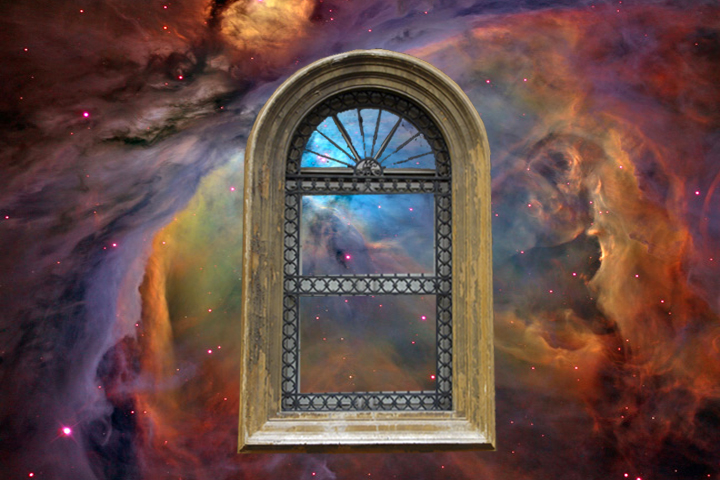
Window on the galaxy
As an artist and musician, I am always seeking the point of entry to liminal space which, for me, is the marker of creative engagement. Quantum physics suggests that all possibilities exist until observation or intention selects one possibility which then becomes “the” reality. As a composer, this is exactly the process through which I move. I start with an idea, I do research and entertain many possibilities, then I withdraw into that “space between” to let everything cook and stew while I seek to become quiet and receptive and balanced. I stand on the threshold, poised but not ready to commit. Stepping through the threshold, moving from possibility to a chosen act or decision, always seems the most difficult part – actually stepping through and be willing to choose “this” but not “that” becomes an act of creative courage.
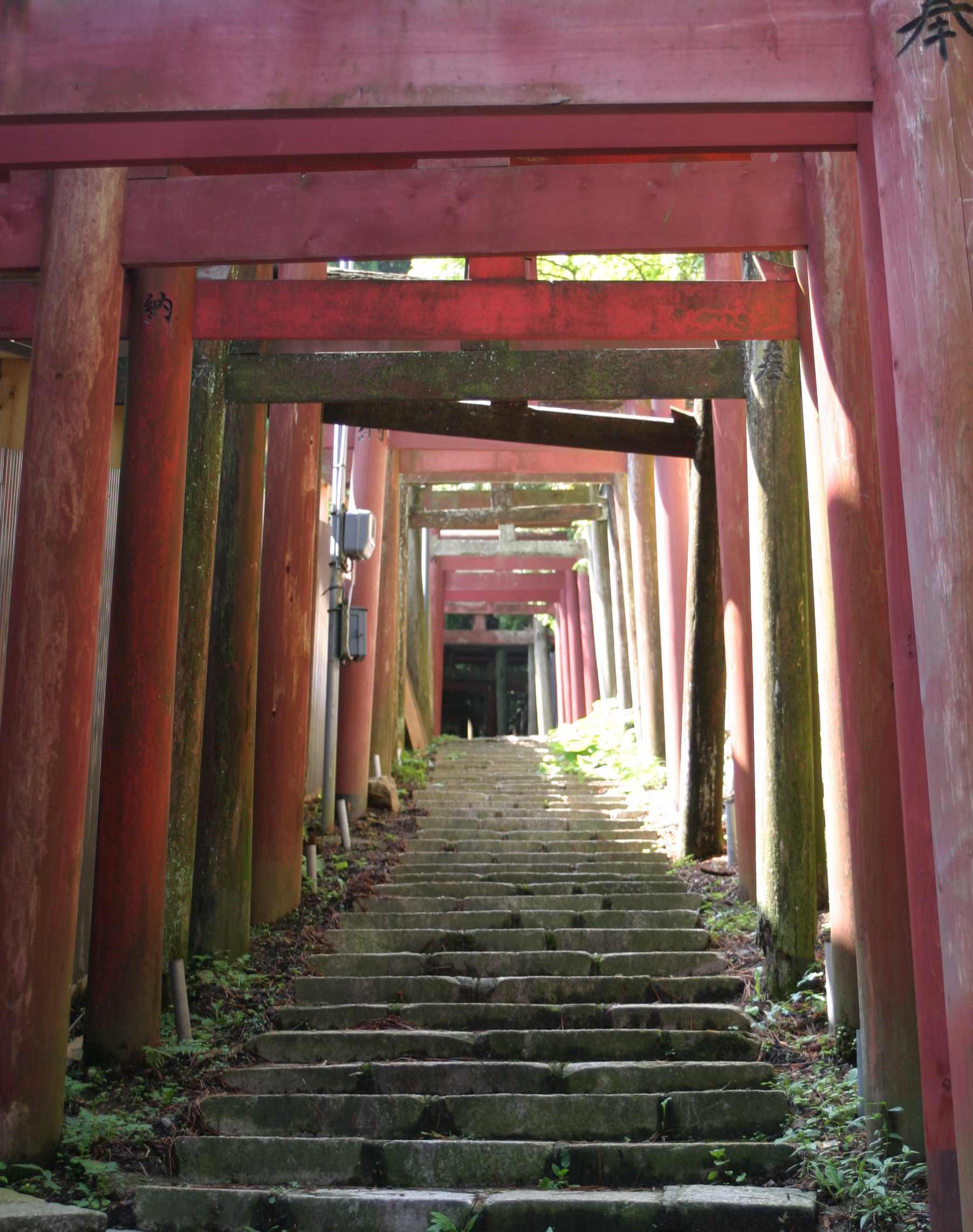
A series of thresholds
Of course, that is only the first step; it is actually a series of decisions, reflections, and more decisions, an ongoing process of stepping into a threshold, a liminal space, then continuing on through the process, over and over again. Singer/songwriter and artist Joni Mitchell once drew an analogy between painting and composing – when the painting was finished, it was finished, but the music demanded an ongoing commitment to bring it to life – this is probably true of all performing arts. (Photo courtesy of Joka2000 on Flickr)
The next time I post, I hope to have a piece of music to share. (You can now hear the music for Breath) For now, I stand poised on another threshold, seeking the silence and stillness between breaths that nourishes me, balances me and leads me to the next step, through the next doorway.
Reality is that place between the sea and the foam. Irish Proverb
“Blue, blue, my world is blue …” English lyrics to “L’Amour Est Bleu/Love is Blue”
These lyrics echoed through my head as I walked through my garden this weekend, surrounded by clouds of blue forget-me-nots, tall wands of Camassia quamash (a native wild hyacinth) and the shorter spires of English bluebells and purple Ajuga. The garden is in its bluest moment, in bright contrast to the golden leaves of Spireas and hostas and the fresh green foliage of the woods. My world is truly blue.
This slideshow requires JavaScript.
Perhaps you remember the song “Love is Blue” written by Andre Popp – “the only number-one hit by a French artist to top the Billboard Hot 100 in America.” (Wikipedia) Made famous as an easy listening instrumental hit by French orchestra leader Paul Mauriat in 1968, it was more recently featured in “The Blue and the Gray” episode of The Simpsons in February, 2011. The song was first introduced through the Eurovision Song Contest in 1967 where it placed fourth. Here is charming footage of Greek singer Vicky Leandros singing “L’Amour Est Bleu” in the original television program that launched the song.
As someone who is attentive to both color and the elements of nature, I find it fascinating that the original French lyrics written by Pierre Cour compare the pain and beauty of love to both colors (blue and grey) AND elements (water and wind) while the English version by Brian Blackburn focuses only on colors (blue, grey, red, green, and black). Here are the original French lyrics with English translation and here are the English lyrics written by Blackburn.
In addition to the original French pop song and its instrumental version by Mauriat, it has been recorded in an instrumental rock version by Jeff Beck, and a soul version by the Dells. Here’s my favorite French version by Claudine Longet but the one that really knocks my musical socks off is the soul version by The Dells. They sang a medley of I Can Sing a Rainbow/Love is Blue that still gives me goosebumps for its power and passion – an incredible vocal group, The Dells take this song to a new level.
And finally, a video of Paul Mauriat (1925-2006) conducting his instrumental version of “Love is Blue.”
All paths are the same, leading nowhere. Therefore, pick a path with heart! Carlos Castaneda
Dusk is falling, I am determined to renew the mulch of my garden paths but the length of day challenges me. The design of this part of the garden depends on the paths – they define and shape everything. Without them I cannot expect to stroll the garden nor photograph it. So each spring, I renew the garden paths.
As I work quietly, I begin to consider how frequently “the path” serves as a metaphor for life, for making choices, for encountering difficulties, for taking the easy way out, for pursuing an adventure. According to American psychologist James Hillman “Sooner or later something seems to call us onto a particular path… this is what I must do, this is what I’ve got to have. This is who I am.” Italian psychologist and criminologist Cesare Lombroso wrote “Good sense travels on the well-worn paths; genius, never. And that is why the crowd, not altogether without reason, is so ready to treat great men as lunatics.” Thoreau exhorts us to “Pursue some path, however narrow and crooked, in which you can walk with love and reverence” but Spanish poet Antonio Machada states “Travelers, there is no path, paths are made by walking.” Personally, my favorite path saying is by Groucho Marx – “A black cat crossing your path signifies that the animal is going somewhere.”
This slideshow requires JavaScript.
In the garden, a path is literal, practical, yet highly symbolic. Visually, it leads the eye and the foot, like a giant arrow pointing the way. There may be unexpected twists and turns, creating places for plant treasures, ornaments, a bench. This particular part of my garden was designed to be seen from the decks above it, not unlike the Elizabethan knot gardens that were meant to be viewed from a high castle window. The garden beds are both defined and connected by the paths.
Before the dark drops so deeply into the garden that I must retreat, I look at the paths with a sense of satisfaction. Task finished for the year, the paths are clear and ready for use, and I walk them home.
One never reaches home, but wherever friendly paths intersect, the whole world looks like home for a time. Hermann Hesse
And the river bank talks of the waters of March
It’s the promise of life, it’s the joy in your heart – from “Waters of March” byAntonio Carlos Jobim
The Waters of March (Águas de Março ), written by Antonio Carlos Jobim, reflects the end of summer, which is March in Brazil. For those of us in the Northern Hemisphere, it suggests the beginning of spring, “the promise of life in your heart”.
March is here and is it full of the promise of life. As I bend again and again to weed and clear the detritus of winter and uncover the emerging blooms and greening leaves, I hear in my mind the lovely repetitive melody of this sensuous and philosophical song by Jobim, the composer and musician who made Brazilian music accessible to the rest of the planet.
The Waters of March was originally intended to list the passages and events of life that flow and ebb and culminate in the waters of March, a stormy and wet time at the end of summer in the southern hemisphere of Brazil. In the northern hemisphere, March is also stormy and wet but also the beginning rather than the end of the growing season. As the rain and storms bring us green leaves, bird song, and early blooms, we can consider the beauty of the song and the reality of nature’s astonishing gifts of blossom and promise. Here are a few images of new life in my garden this week, a stream of life in the waters of March.




 composerinthegarden