A composer by vocation, a gardener by avocation. My garden and my life as a composer are deeply intertwined - the yin and yang of my creative life. . .
I like good strong words that mean something. ~ Louisa May Alcott
“What’s in a name? That which we call a rose by any other name would smell as sweet.” Shakespeare
A week of very hot weather and a very intense teaching schedule has come to a close. After a quiet morning spent re-acquainting myself with my garden and my family, I find that I am a little short of words. I’ve used up so many of them this week that I’ve decided to share a clever video from Radiolab, all about words.
Many thanks to my student John who shared this video with my class. Enjoy!
Hemerocallis or daylily – from the Greek “hemera” (day) and “kalos” (beautiful) translated as “beauty for a day” – a hardy perennial native to China, Japan, and Korea whose flowers last for only one day
Although I have been deep in multiple projects for the past two weeks, I found time the past few mornings to grab a few photos from the garden. The intense heat has driven garden bloom from rose season into daylily season.
I love daylilies for their huge variety of color, shape, size and durability. If you are only familiar with the orange roadside dayilies, you may be surprised to find that there are literally thousands of modern hybrids to choose from, often with fanciful names and exotic shapes and patterns. I love coordinating daylily bloom colors with other flowers and foliage. One of my favorite color beds in the garden is the “grape and lemonade” bed – cool lemons and deep purples, a color scheme inspired by daylily ‘Etched Eyes’ hybridized by Matthew Kaskel.
Here are a few portraits of the early season bloomers. For more information on the wonderful world of daylilies, visit the American Hemerocallis Society.
Milestones are constructed to provide reference points along the road. This can be used to reassure travelers that the proper path is being followed, and to indicate either distance travelled or the remaining distance to a destination. (Wikipedia)
When we were kids riding in the family car, my dad would always announce an upcoming rollover in the car mileage. Turning over to the next thousand miles was a big deal and we all leaned over the front seat to watch the numbers change from many 9’s to many 0’s, then gave a big cheer!
I relived that experience this week on WordPress, my vehicle for communicating and sharing. I try not to obsess about stats but rather use them “as a reference point along the road” and to reassure myself that “the proper path is being followed.”
I’ve been blogging for a little over ten months, once a week, with a rare mid-week post. This blog has helped me enormously in finding a voice and creating a welcome challenge to express myself and share my ideas, images, and music. Little did I anticipate how many wonderful people I would meet and learn from along the way. So, when I saw my 100th Follower (thank you, Historic Virginia Plantation) and my 10,000th View appear on the same day, and my 500th Like a few days earlier, it felt like a milestone reached and I gave a little cheer when the numbers rolled over. For many of you, I am sure these are small numbers (and it is probably very impolite to make them public!) but to me, they represent a valuable contact with others that I wouldn’t have had if I had never begun to blog. And so, I want to express my deep thanks to those who read and follow and visit and comment – you are never taken for granted! Blogging continues to be a pleasure rather than an obligation and I hope that it remains that way.
Milestone: An important event, as in a person’s career, the history of a nation, or the advancement of knowledge in a field; a turning point. (The Free Dictionary)
All happiness depends on a leisurely breakfast. ~John Gunther (American journalist & author)
This morning was a perfect moment – the air cool but not chilly, the sky a clear blue, and a light breeze bringing the fragrant scents of the garden up to the deck. I celebrated with a long lingering breakfast in the Treetop Bistro, the name for our upper deck.
The two decks along the back facing the woods were a big factor in choosing this house. The upper deck, reached by a spiral staircase, was where I originally planned the garden. The perfect place for morning coffee, it started out as a calm blue and cream place with wicker chairs, a birdbath, and some potted plants, and served its purpose well.
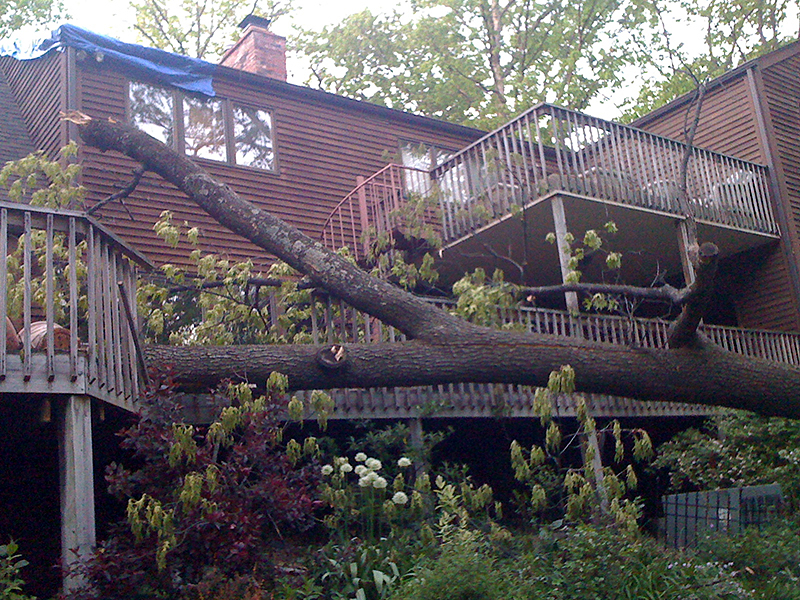
But then two years ago, with a thunderous crash, a huge old oak fell on the house on a calm windless day, taking out the lower deck, part of the roof, part of the upper deck, and most of the furniture and pots. Fortunately, no one was hurt, but the garden and decks were a construction zone all summer.
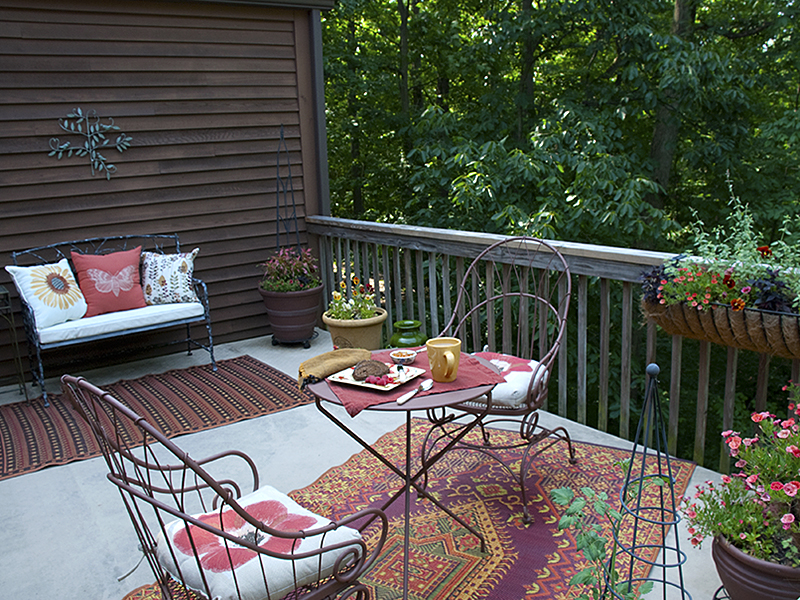
It seemed a good time to rethink the upper deck; I wanted to create a colorful hideaway for a cup of morning coffee or a glass of evening wine. Taking into account the dark brown house and the green wall of treetops, I settled on a mix of rose, coral, orange, gold, and dark red. The area rugs are actually woven vinyl, called Mad Mats, an inexpensive but attractive way to create the feel of an outdoor room, easy to hose down all summer and roll up to store for the winter. Brown outdoor paint pulled together a mish mash of furniture, a few pillows were added, and the “bistro” was born.
Not only did I want a certain color scheme that was warm and cheerful, I wanted the feel of a secluded bistro like so many I have visited in France, Italy, and Spain, tucked away in a side street and surrounded by old trees. Hayracks and pots holding flowers, herbs, lettuces, and tomatoes turned it into a lush kitchen garden as well.
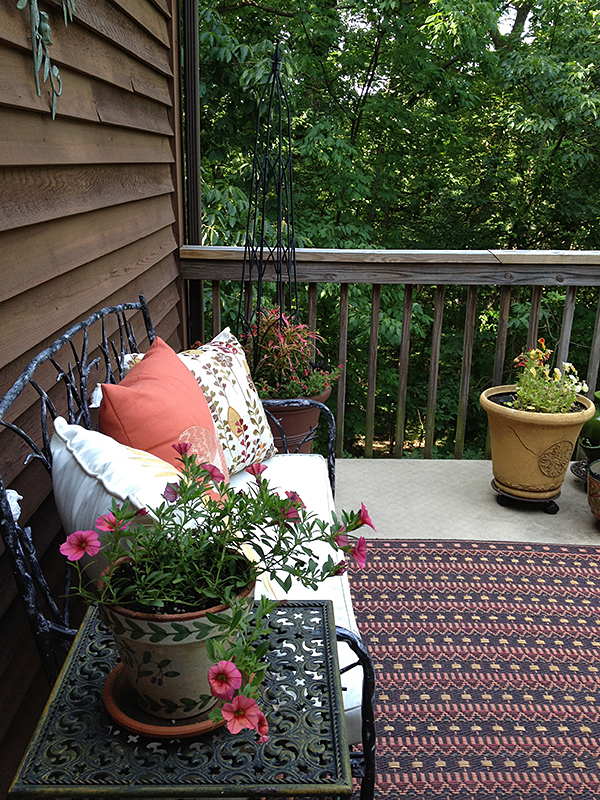
The bench invites a quiet moment in the treetops.
Sometimes Angel Eyes takes a nap on the bench.
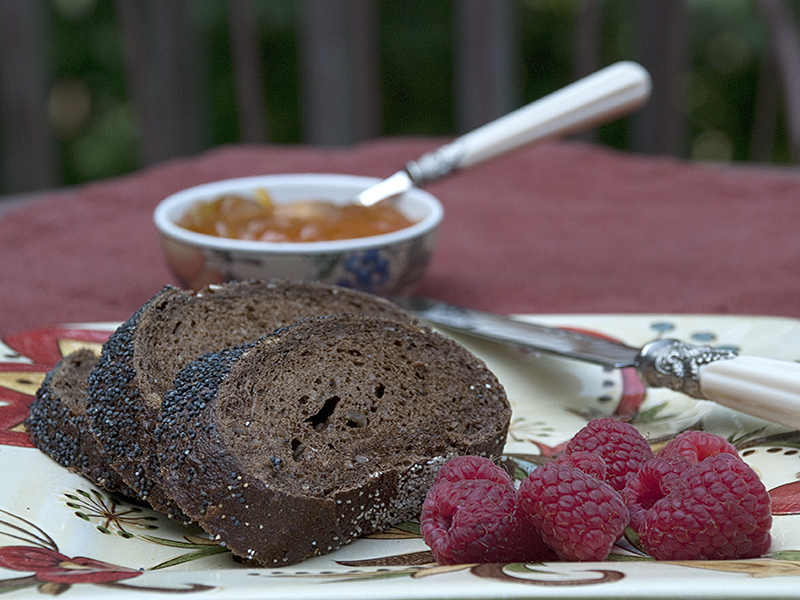
And breakfast? It was delicious!
Want to see what the plantings will look like by the end of summer? See a slideshow from last September that includes some photos of the Treetop Bistro’s first season.
I had to delay the video deconstruction of “Breath” until a later date because of work on several projects; next week, I hope to premiere the second part of The Four Elements – “Light”. Enjoy your weekend!
Two weeks ago, I premiered the piece “Breath” on this blog, as both a music video and an mp3 download. Photographer and fellow blogger Kerry of Lightscapes Nature Photography Blog made a comment that has been circling in my mind ever since.
“I remain in awe of what it takes–the synthesis–to create something like this. It’s difficult, bordering on impossible, for me to fathom.”
Since Kerry generously posts about his approach/creative process to landscape photography, I thought I might try the same for the creation of “Breath” in a way that hopefully anyone can understand. Since I teach composition, I have had to become more aware of the compositional process – and I learn more about my own process each time I “deconstruct” a piece.
The Idea/Inspiration
For me, a musical idea is often triggered by an event or a powerful moment or insight. In this case, “Breath” is part of a larger suite of pieces making up The Four Elements. I was inspired to use the idea of breath for the element of air from three sources; one was my yoga practice and the deep breathing that it teaches. The second was watching the leaves on the trees around my house dancing in the wind, as if the earth was breathing in and out. The third was a video of experimental composer and performance artist Pamela Z, who used her breath against sheets of metal in “Metal Voice” from “Voci.” So, all I knew starting out was that there would be breath sounds and the text would explore the meaning of breath, while the music would try to capture the rhythm of leaves moving in the wind as well as the silence between breaths.
The Research I explored many concepts and ideas about breath and was surprised to find that across most cultures and religions, a word for breath existed that meant not only the physical act of breathing but a metaphysical act of breath – “breath of life, breath of energy”- a means of connection with a greater spiritual power. Many pages of notes later, I found certain phrases and words coming up over and over again, and from those writings, a rough draft of lyrics was created. This could be compared to scouting a location for photography or exploring a historical period for a story and creating an outline from notes.
Letting It Cook
An under-rated part of the creative process is gathering all of these ideas and letting them simmer beneath the conscious mind, just like giving bread dough enough time to rise. Ideas would percolate while I was working in the garden, driving in the car, walking the dog and I began to get a sense of the rhythm of the words and music. If I move to the piano or the computer too soon, before I hear the music internally, my hands compose instead of my head, and I end up falling into automatic habits, not unlike taking the highway exit to go to work out of habit when you really are headed somewhere else. So I have learned to allow everything to slowly simmer and come together internally before I begin the actual writing process. If I wait long enough, the piece takes on a life and rhythm of its own that I then follow like a story unfolding.
Committing to Paper
If I am writing a song, lyrics almost always come first but their rhythm and inflection become quickly bonded with musical ideas. A rough sketch of lyrics and the idea that I wanted to have a “world music” sound that was inspired by gamelan music started the process and tied it to the other pieces in The Four Elements. Gamelan music is played mainly on percussion instruments and consists of many overlapping patterns of notes called ostinatos. Combining different patterns creates a floating rhythmic quality without an obvious strong beat, similar to the way an artist might layer color after color to create a complex but subtle painting. Here is a short video that explains how I created the rhythmic elements that underpin the piece.
The Final Mix
After the premiere of “Breath” by my student electronic ensemble, I returned to the original arrangement and began to customize it for my own performance and recording. Several days of experimentation in my studio produced synthesizer tracks that were then taken into the audio studio for adding voice, bass, and other tracks. Many test mixes were created for listening on many different sound systems, from the living room stereo to the car CD player to sound systems in music stores. My husband, who has golden ears, fantastic technical skills, and boundless patience, filled the role of audio engineer and producer admirably. A final upload of the piece to CD Baby completed the audio project.
I hope you enjoyed the”behind the scenes” explanation of how I compose music. Next week, I’ll talk about the video I created for “Breath” – and show you what didn’t make the cut!








 composerinthegarden