I wonder if the snow loves the trees and fields, that it kisses them so gently? And then it covers them up snug, you know, with a white quilt; and perhaps it says, “Go to sleep, darlings, till the summer comes again. ~ Lewis Carroll
The first fall of snow is not only an event, it is a magical event. You go to bed in one kind of a world and wake up in another quite different, and if this is not enchantment then where is it to be found? ~ J.B. Priestley
Listen! The wind is rising, and the air is wild with leaves ~Humbert Wolfe
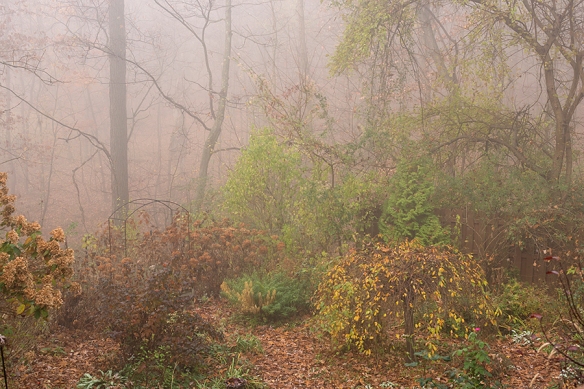
Last week, a misty morning turned the garden into a place of magic and mystery.
The garden in mist
Bench in the mist
Through the maple leaves
The mulberry in mist
Mulberry tree over the fence
A few days later, a wild wind carried winter in its arms and spun the color from the trees into the air.
And then it snowed for two days.
Maple leaf in snow
Zelda contemplates winter
Chinese dogwood leaves
Bloodgood maple leaf in snow
Anise hyssop with snow
In spite of the recent snow and freezing temperatures, the garden still offers moments of beauty. In a world that seems to have gone mad, the garden remains a place for quiet reflection, solace for frayed emotions and restless thoughts. Everywhere I look, there is richness of texture, of color, of light sifting through the trees, mist flowing down the hills. As I step on carpets of fallen oak leaves rimmed with morning frost, the world seems alive and abundant. A family of deer sidle by the fence, the red-tailed hawk whistles its distinctive cry, chipmunks scuttle under the stone walls, bluejays and cardinals drink from the birdbath. A few roses linger next to the russet leaves of autumn shrubs, the carpets of Ajuga glow with their dark winter foliage. Until the snows come in earnest, the garden is a cornucopia of life.
At no other time (than autumn) does the earth let itself be inhaled in one smell, the ripe earth ~Rilke
For my American friends, I wish you a joyful Thanksgiving; to all my friends and readers, I wish you a cornucopia of abundance in your lives.
There is a lie that acts like a virus within the mind of humanity. And that lie is, “There’s not enough good to go around. There’s lack and there’s limitation and there’s just not enough.” The truth is that there’s more than enough good to go around. There is more than enough creative ideas. There is more than enough power. There is more than enough love. There’s more than enough joy. All of this begins to come through a mind that is aware of its own infinite nature. ~Michael Beckwith
Tonight the sky was clear and yesterday’s supermoon reappeared in full glory – the earth, moon, and sun are all in a line, creating a syzygy. I had never heard this term before my student Ryan Bromley brought a composition to the electronic ensemble entitled Syzygy. The piece was a success and my husband liked it so much that he recorded it with Ryan for his Tribute CD.
Listen to the clip generously provided by Bill Purse while viewing a few images of the garden and woods in their autumn glory.
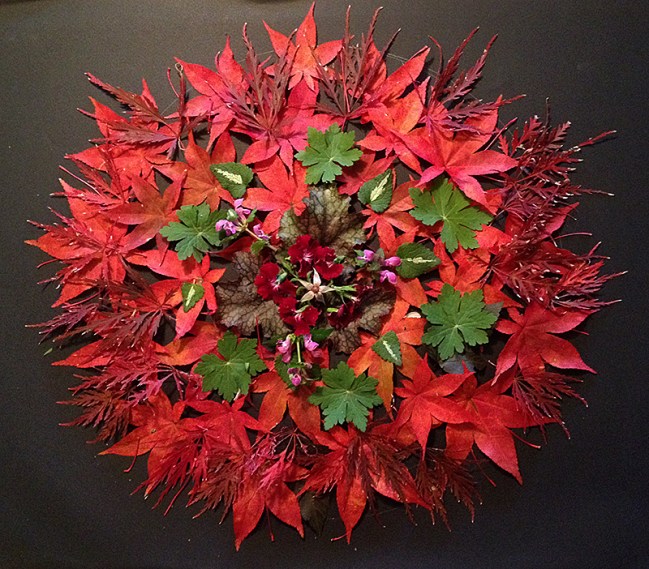
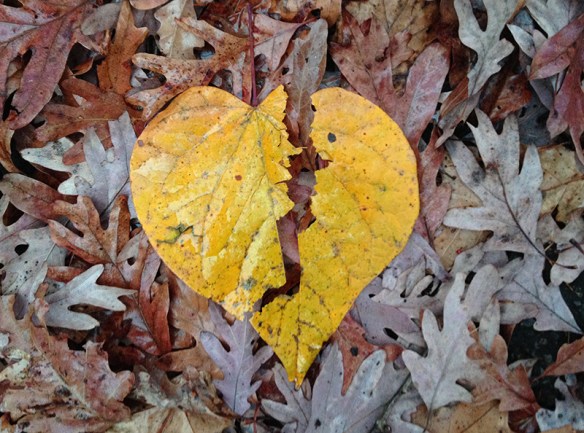
In celebration of autumn color and inspired by the work of nature artist Andy Goldsworthy, I assembled an ephemeral piece of leaf and flower.
Now Autumn’s fire burns slowly along the woods and day by day the dead leaves fall and melt. ~William Allingham
Nature’s message was always there and for us to see. It was written on the wings of butterflies. ~Kjell B. Sandved
The garden in August is as much a garden of creatures and sound as it is of flowers. As the flowering season comes to a crescendo, the garden becomes a “last chance buffet” for every creature gathering food stores for winter or for migration. The cicadas buzz in the woods throughout the day; in the evening, the frog chorus breaks out into pulsing serenades of courting. Bees of every size and shape buzz around the richest sources of pollen, butterflies flitter and float through the air and compete with the bees for flower landing space, hummingbirds visit every tubular flower for nectar. This is the time of the year that the gardener needs to step aside and enjoy a ringside seat to the panorama of life in the garden. Here’s a sample of the frog chorus at night. (Audio recorded and edited by Bill Purse)
A few years ago, a serious health crisis made me an observer rather than a participant in my garden for a season or two. Even as the weeds grew unhindered, the flowering plants also bloomed without my help and were covered in bees and butterflies for months. It became apparent to me that tidiness was not a priority of Mother Nature; her priority apparently was growth abundant, unruly and rich with life. While I still enjoy playing with color and texture and form, my garden priorities are now more aligned with those of Mother Nature to support the life of creatures around me. Happily, creating a refuge for pollinators can also result in a beautiful refuge for the gardener.
We have entered an age of environmental gardening. Given the afflictions of our planet, this is overwhelmingly positive as long as we remember that the one creature most in need of refuge in the garden is the gardener. ~Adrian Higgins, The Washington Post
Each morning, Angel and I explore the garden. It is lush and overflowing, full of wings and buzzing and singing.
This slideshow requires JavaScript.
The hillside that in July was covered with daylilies is now overflowing with the cheerful gold of native brown-eyed Susans (Rudbeckia hirta and R. triloba) that are favorites of both butterflies and bees.
This slideshow requires JavaScript.
Golden flowers abound this time of year and are a favorite of pollinators. For the first time, the Silvery Checkerspot butterfly has made an appearance. (Click on any image in the mosaic to see the full size photo).
Silvery checkerspot butterfly on Rudbeckia triloba
Rudbeckia triloba
Rudbeckia hirta ‘Viette’s Little Suzy’
Bee in species daylily
Bee headed for Digitalis lutea
The deck garden is anchored on one end by a large stand of purple coneflowers and on the other end by single roses and Persicaria ‘Firetail’ – all attract a bevy of native bees and butterflies throughout the day.
Echinacea purpurea ‘Ruby Star’
Bee and Echinacea
Single rose ‘Carefree Beauty’
Bee on Persicaria ‘Firetail’
Yellow swallowtail butterfly
Lush Hydrangea blossoms form a backdrop to a tall swath of native Phlox paniculata in shades of lavender and purple, a favorite of the yellow swallowtail butterflies. Planting in groups helps pollinators gather food with the least energy expended, so I’ve begun to allow their favorite plants to increase and spread. Birdbaths tucked into flower beds provide essential water.
Pollinator on Hydrangea ‘Limelght’
Phlox paniculata ‘Franz Schubert’
Agastache ‘Blue Fortune’
Phlox and Hydrangea
Birdbath, ostrich ferns, and hosta
Every garden is a work in progress and changes over time. I have been gently steering my garden toward one that supports winged life – this year it was certified as a Pollinator Friendly Garden through the Penn State Master Gardeners program. Just one more step in creating a place where all the parts fit and work together as a whole. Want to know more? Visit pollinator.org for information on National Pollinator Week and easy steps you can take to support life on our planet.
The first law of ecology is that everything is related to everything else. ~Barry Commoner, American scientist
 This week, winter arrived. An all day snow turned the world into a festive snowy wonderland that I could barely see during a slow drive home from work in the dark. Morning brought blue skies and golden sun and revealed the white fairytale forest around me. You might enjoy listening to the unusual arrangement of Winter Wonderland by Pentatonix (below) while you look at the snow photos – click on any photo in the mosaic to see a full size image. (All still images ©2016 Lynn Emberg Purse)


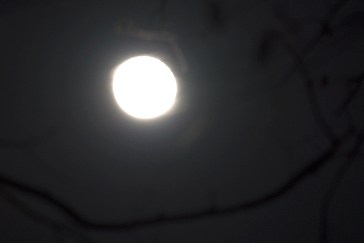 Tonight the sky was clear and yesterday’s supermoon reappeared in full glory – the earth, moon, and sun are all in a line, creating a syzygy. I had never heard this term before my student Ryan Bromley brought a composition to the electronic ensemble entitled Syzygy. The piece was a success and my husband liked it so much that he recorded it with Ryan for his Tribute CD.


 The garden in August is as much a garden of creatures and sound as it is of flowers. As the flowering season comes to a crescendo, the garden becomes a “last chance buffet” for every creature gathering food stores for winter or for migration. The cicadas buzz in the woods throughout the day; in the evening, the frog chorus breaks out into pulsing serenades of courting. Bees of every size and shape buzz around the richest sources of pollen, butterflies flitter and float through the air and compete with the bees for flower landing space, hummingbirds visit every tubular flower for nectar. This is the time of the year that the gardener needs to step aside and enjoy a ringside seat to the panorama of life in the garden. Here’s a sample of the frog chorus at night. (Audio recorded and edited by Bill Purse)


 Every garden is a work in progress and changes over time. I have been gently steering my garden toward one that supports winged life – this year it was certified as a Pollinator Friendly Garden through the
  composerinthegarden